
Wallet Rotation vs Shielded Execution
More wallets do not automatically mean more privacy.
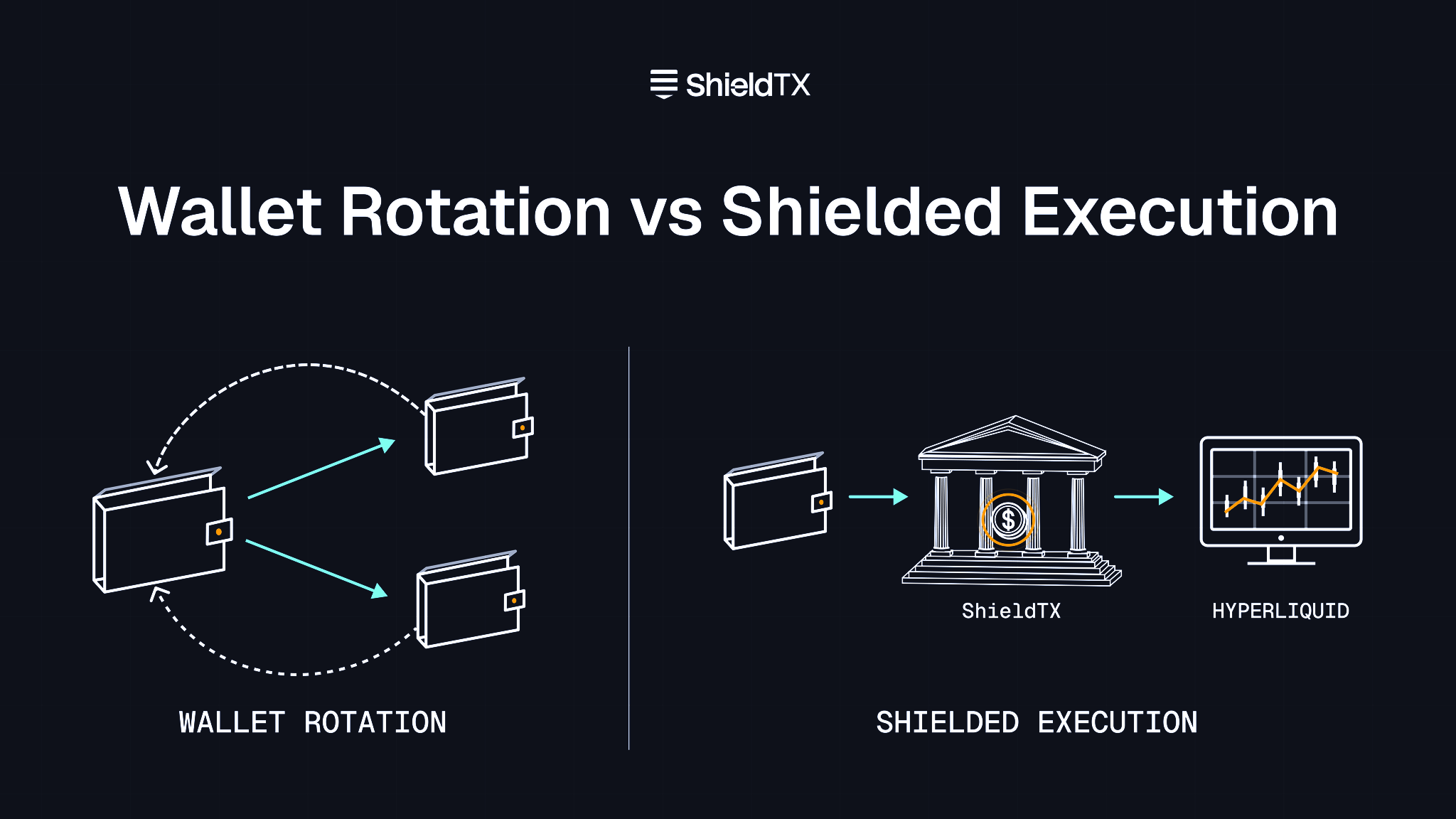
Wallet rotation and shielded execution solve the same concern differently
Onchain perpetual trading makes positions easy to inspect. Once a wallet becomes associated with a trader, fund or desk, observers can track its direction, approximate entry, leverage, unrealised PnL, liquidation level and trading history. That visibility can turn a public wallet into a persistent source of trading intelligence.
Two approaches are often used to reduce this exposure: manually rotating between wallets or routing trades through a shielded execution system. Both aim to reduce direct attribution, but they work at different layers and create different operational tradeoffs.
Wallet rotation is an address-management practice. Shielded execution is an execution workflow. The important question is not how many wallets are involved, but whether the funding path and the resulting positions can still be linked to the same trader.
What wallet rotation means
Wallet rotation means using different wallet addresses for different trades, strategies or periods of activity. A trader may stop using one address and move to another, or maintain several wallets at the same time to separate positions.
At first glance, a new address can look like a new identity. In practice, that separation depends on how the wallet is funded, when it trades, what it trades and how consistently the trader repeats the same behaviour. Creating another wallet changes the visible address. It does not automatically remove the evidence connecting that address to earlier activity.
Why traders rotate wallets
- Strategy separation. Different addresses can keep discretionary, systematic, hedging or experimental activity apart.
- Operational organisation. Teams can assign wallets to mandates, traders or risk limits and reconcile them separately.
- Reduced concentration. One public address no longer contains every position and the trader's complete visible history.
- Basic pseudonymity. A fresh address may initially be less recognisable than a long-used wallet associated with a person or institution.
These are valid operational benefits. None of them, however, change what an observer can see on Hyperliquid. A new wallet can still be traced through its funding path, and a fresh address that trades the same markets at the same size and timing as the original wallet is not a new identity, it is the same trader behind a different label. Operational separation organises activity. It does not break the public link between the trader and the resulting positions.
Where manual wallet rotation breaks down
Funding paths can reconnect the wallets
If several trading wallets receive funds from the same public source, those transfers can create an observable relationship. Moving funds through the same sequence of addresses can make the pattern even easier to follow. A fresh destination address is less useful when its source is already known.
Timing and trade size can create clues
A new wallet funded shortly before a familiar trade, using similar position sizes or entering the same market and direction, may still be associated with the earlier wallet. No single clue proves common ownership, but repeated signals can strengthen the inference.
Trading behaviour can act like a fingerprint
Market selection, order timing, leverage, position adjustments and closing behaviour can form a recognisable pattern. Rotating the address does not rotate the strategy behind it.
More wallets increase operational burden
Each additional wallet introduces another key, balance, permission set and transaction history to monitor. For a professional desk, that means more funding operations, reconciliation, reporting and incident-response work. Manual processes also increase the chance of using the wrong wallet or sending funds to the wrong address.
Capital and history become fragmented
Balances distributed across many wallets can be harder to deploy and monitor efficiently. Trading history, realised PnL and risk data may also need to be reconstructed across multiple addresses before a desk can see its complete exposure.
What shielded execution means
Shielded execution places a privacy layer between the trader's funding wallet and the wallet used to hold and execute a position. Instead of the trader manually creating, funding and managing a collection of wallets, the execution system manages the separation as part of the trading flow.
This does not make the market activity invisible. On Hyperliquid, the position, orders and resulting PnL remain visible at the execution wallet. The privacy objective is narrower: reduce the direct public link between that execution wallet and the trader's recognised funding wallet.
The quality of that separation depends on the design of the system. Traders should review the funding model, smart contracts, permissions, withdrawal path, latency, costs and what information remains observable before treating any product as private.
Wallet rotation vs shielded execution at a glance
| Dimension | Manual wallet rotation | Shielded execution |
|---|---|---|
| Core method | The trader creates and switches between addresses | A privacy layer separates funding from position execution |
| Wallet management | Handled manually by the trader or desk | Managed within the execution workflow |
| Funding relationship | Can remain visible when wallets share a known source | Designed to reduce the direct public link to the funding wallet |
| Position visibility | Visible on the active trading wallet | Visible on the execution wallet |
| Behavioural inference | Still possible from timing, size and strategy patterns | Still possible because market activity remains public |
| Operational overhead | Grows with every additional wallet | Concentrated in one product workflow |
| Key management | Multiple keys or delegated permissions to manage | Depends on the product's control and permission model |
| Execution venue | Depends on where each wallet trades | Can preserve execution on Hyperliquid's native order book |
| Primary tradeoff | More control but more manual complexity | Simpler separation but added product, contract, fee and latency considerations |
How ShieldTX approaches shielded execution
ShieldTX is a non-custodial execution privacy layer for Hyperliquid perpetuals. The trader funds a ShieldTX balance and submits a perp order through ShieldTX. A fresh trading wallet is funded to route the order to Hyperliquid's native order book. When the position is closed through ShieldTX, the proceeds return to the shielded balance.
The fresh trading wallet is part of the execution path, not another wallet the trader must manually create, fund and reconcile. The position remains visible on Hyperliquid, but ShieldTX is designed to prevent it from being publicly tied to the trader's main wallet in the same way as a direct trade.
ShieldTX does not remove price movement, slippage, funding, leverage, liquidation, smart-contract, venue or operational risk. Shielded routing also adds a delay of a few seconds, and ShieldTX fees are shown separately.
A simple comparison of the two workflows
Manual wallet rotation
- Create a new wallet. Generate and secure another key or configure another account.
- Fund the wallet. Move collateral into the new address through a path chosen and managed by the trader.
- Trade directly. Open and manage the position from that wallet on Hyperliquid.
- Reconcile and rotate again. Track balances and history, withdraw funds, and repeat the full four-step cycle for the next trade. After ten trades, manual rotation has produced ten wallets, ten funding transfers, ten reconciliations, and ten times the key-management and reporting overhead.
Shielded execution through ShieldTX
- Fund ShieldTX. Deposit USDC into the ShieldTX balance. The deposit into the system remains visible onchain.
- Submit the order. Place the Hyperliquid perp order through the ShieldTX application or an approved API workflow.
- Execute through a fresh trading wallet. ShieldTX funds the wallet and routes the order to Hyperliquid's native order book.
- Close and settle. Close through ShieldTX and return the proceeds to the shielded balance or simply trade again and another new wallet will be created.
What remains observable in both models
Neither model makes public market activity disappear. Observers may still see:
- The execution wallet. The wallet holding the Hyperliquid position remains public.
- The position. Market, direction, size, leverage, PnL and liquidation information may remain visible.
- Trading behaviour. Timing, order changes and repeated strategy patterns can still support inference.
- System entry and exit. Onchain deposits into and withdrawals from a privacy system may remain visible even when the internal execution link is reduced.
Privacy should therefore be evaluated as a boundary, not a binary label. Traders should ask exactly which relationship is reduced and which signals remain public.
When each approach may fit
| Situation | Likely fit |
|---|---|
| A trader wants simple organisational separation between strategies | Wallet rotation or Hyperliquid subaccounts may be sufficient |
| A desk needs full manual control over every address and funding action | Wallet rotation may fit, with added operational responsibility |
| A trader wants to reduce the direct link between a known funding wallet and each position | Shielded execution is the more relevant model |
| A systematic desk wants privacy separation inside an API workflow | A shielded execution layer with suitable API access may fit better |
| A team cannot accept added smart-contract, integration or routing risk | Direct execution and internal wallet controls may be preferable |
The choice is not always either-or. A professional trading operation may use separate wallets for custody and mandate controls while using shielded execution for selected positions. The final model should reflect the desk's privacy requirements, operating procedures and risk limits.
What to review before choosing
- Privacy scope. What link is being reduced, and can funding, timing or behaviour still reconnect the activity?
- Control model. Who controls keys, contracts, permissions, withdrawals and emergency actions?
- Execution quality. Where do orders execute, which order types are supported and what latency is introduced?
- Operational load. How many wallets, keys, transfers and reconciliation steps must the team manage?
- Economics. What fees, gas costs and capital fragmentation result from the chosen approach?
- Risk and governance. How will legal, compliance, security, accounting and incident-response teams review the workflow?
Check what your current wallet reveals
If you already trade perps on Hyperliquid, use the ShieldTX wallet scanner to see how many wallets entered the same market and direction shortly after your trades. The scanner uses activity from the last 30 days. Scan your public Hyperliquid wallet exposure.
How to access ShieldTX
ShieldTX is onboarding professional traders through a private beta. Trading desks and systematic teams can request early API access for integration into existing workflows.
Frequently asked questions
Is using a new wallet the same as trading privately?
No. A new address may initially be less recognisable, but funding paths, timing, trade size and behaviour can still connect it to earlier activity.
Does ShieldTX use fresh wallets?
Yes. ShieldTX uses a fresh trading wallet in the execution flow. The difference is that the wallet is funded and managed through the ShieldTX workflow rather than manually rotated by the trader.
Are ShieldTX positions invisible on Hyperliquid?
No. Positions and market activity remain visible on Hyperliquid. ShieldTX is designed to reduce the direct public link between the funding wallet and the fresh wallet holding the position.
Do Hyperliquid API wallets provide trading privacy?
No. API wallets delegate signing authority. Hyperliquid documentation states that account data is queried using the actual master or subaccount address.
Can subaccounts replace wallet rotation?
Subaccounts can organise balances, strategies and permissions. They are useful for operations, but they should not be treated as an execution-privacy feature.
Does shielded execution remove liquidation risk?
No. The position remains subject to Hyperliquid's margin, funding, mark-price and liquidation mechanics.
Which approach is easier to operate at scale?
A managed shielded execution flow can reduce repeated wallet creation, funding and reconciliation work. The desk must still assess the product's smart contracts, controls, fees, latency and integration risk.