Private Spot Trading vs Private Perp Trading
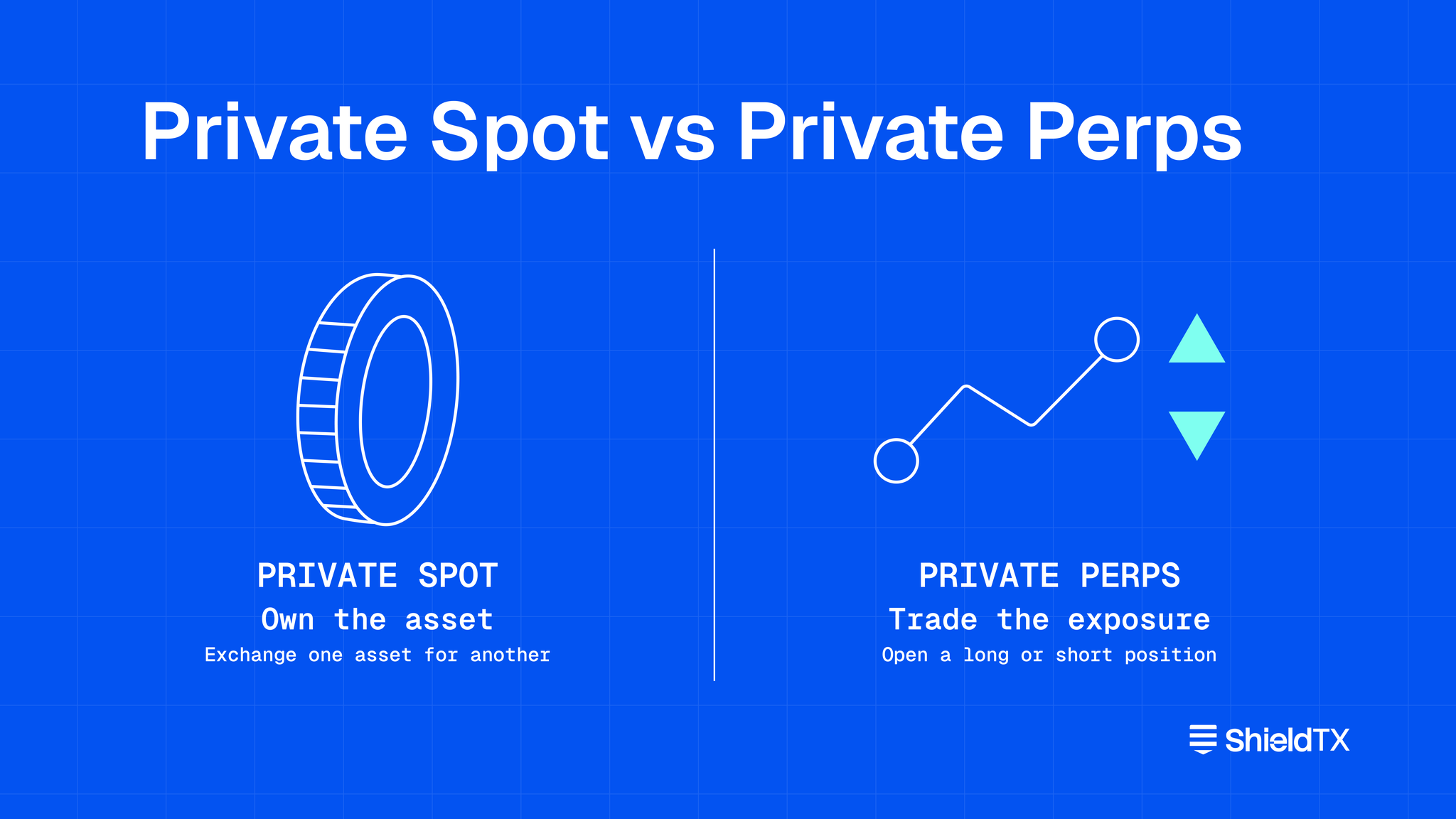
Owning the asset is not the same as trading the exposure.
Private spot trading and private perpetual trading solve different problems
Private spot trading protects an exchange of assets: the trader pays for a token and owns it after settlement. Private perpetual trading protects a derivatives position: the trader posts collateral to gain long or short exposure without taking ownership of the underlying asset. Because a perpetual position stays open, its privacy problem extends beyond the order to position size, leverage, entry price, PnL, funding, liquidation level, and exit.
The practical question is therefore not simply, “Which is more private?” It is, “What are you trading, what information can observers infer, and for how long does that exposure remain useful?”
What private spot trading protects
In a spot trade, one asset is exchanged for another. A buyer of HYPE with USDC receives HYPE; a seller gives up HYPE and receives the quoted asset. Settlement changes the trader’s balances and ownership.
A private spot system may try to reduce the link between the trader, the order, the settlement path, or the resulting balances. The exact protection depends on the design. Some systems conceal amounts or counterparties. Others use private liquidity, shielded balances, intent-based execution, or confidential settlement. “Private spot” is a category, not a single privacy guarantee.
Spot privacy matters when a transfer or swap reveals accumulation, divestment, treasury movement, or a relationship between wallets. But once the exchange settles, there is no open leveraged contract to maintain. The trader owns the asset and faces its price movement directly.
What private perpetual trading protects
A perpetual contract is a derivative with no expiry. The trader uses collateral to open a long or short position rather than buying or selling the underlying asset. Funding payments help keep the contract price aligned with the underlying market, and leverage introduces margin and liquidation risk.
That creates a longer information trail. A visible perp position can expose not only the decision to trade, but also direction, conviction, leverage, approximate entry, unrealised PnL, liquidation pressure, position changes, and the timing of the exit. For a known wallet, this can become a live strategy feed for copy traders, competitors, counterparties, or public commentators.
Private perp trading therefore needs to address position attribution across the full lifecycle. Hiding or isolating the initial order is not enough if the resulting position can still be tied directly to the trader’s main wallet.
Private spot vs private perps at a glance
| Dimension | Private spot trading | Private perpetual trading |
|---|---|---|
| Instrument | The underlying asset is exchanged | A derivative tracks the underlying exposure |
| After execution | The trader owns the asset received | The trader holds an open long or short position |
| Capital model | Usually fully funded for the amount purchased | Collateral can support leveraged exposure |
| Ongoing mechanics | Custody, transfers and later sale | Margin, funding, mark price, PnL and liquidation |
| Primary privacy target | Swap or transfer attribution and resulting ownership | Position attribution throughout entry, management and exit |
| Typical signal leaked | Accumulation, sale or treasury movement | Direction, size, leverage, conviction and liquidation pressure |
| Risk profile | Asset price, liquidity, custody and execution risk | Those relevant risks plus leverage, funding, margin and liquidation risk |
| End state | Asset balance remains until transferred or sold | Position remains until reduced, closed or liquidated |
Why the privacy problem is harder for perps
The exposure persists
A spot execution is a discrete exchange. A perp position continues to generate observable state until it closes. Each adjustment can add evidence about the strategy.
Leverage makes intent easier to read
Position size and leverage can communicate more than a token balance alone. They can reveal conviction, risk limits, hedging behaviour, and proximity to forced liquidation.
The position can become a target
When a known trader’s liquidation level or stressed position is public, other market participants can incorporate that information into their own trading decisions.
Execution privacy and market risk are separate
Preventing a direct public link to a wallet does not remove price movement, slippage, funding, liquidation, smart-contract, venue, or operational risk.
Where ShieldTX fits
ShieldTX is designed specifically for perpetual trading on Hyperliquid. A trader funds a ShieldTX balance, opens a perp through ShieldTX, and a fresh wallet is funded to route the order to Hyperliquid’s native order book. When the position is closed through ShieldTX, proceeds return to the shielded balance.
The position still exists on Hyperliquid and market activity remains observable. What ShieldTX is designed to reduce is the direct public link between the trader’s funding wallet and the fresh wallet that holds the position. This keeps positions, PnL, liquidation levels, order history, and position wallets from being publicly tied to the main wallet.
That scope is important: ShieldTX is not a private spot exchange, a mixer, or a promise that trades disappear. It is a non-custodial execution privacy layer for Hyperliquid perps. Users can fund their ShieldTX balance and place shielded perp trades. Orders route to Hyperliquid's orderbook from a fresh wallet, breaking the link to the original funding wallet.
If you're already trading perps on Hyperliquid you can test your exposure. Our wallet scanner checks your wallet's trading activity and identifies how many wallets are trading in the same market and direction straight after you place your trades. Data is valid for the last 30 days only. Scan your public Hyperliquid wallet exposure.
Which model fits your trade
Choose based on the position you intend to hold, not on the privacy label.
- Private spot trading fits when you want to acquire, sell, transfer, or hold the actual asset and want privacy around that exchange or ownership trail.
- Private perpetual trading fits when you want long or short exposure, may use leverage, and want to reduce the public attribution of the position throughout its lifecycle.
- Neither category has one universal privacy guarantee. Review what remains observable, who can link the activity, how funds are controlled, and which risks remain.
How to access ShieldTX
ShieldTX is currently onboarding traders through a private beta. Traders can request access to the application, while trading desks, systematic traders, and institutions can request API access for ShieldTX to fit into their existing workflows.
Frequently asked questions
Is a private spot trade the same as a private perp trade?
No. A spot trade changes ownership of an asset. A perp trade creates derivative exposure backed by collateral. Their settlement, ongoing state, risks, and privacy requirements differ.
Does private perpetual trading hide the trade itself?
Not necessarily. In ShieldTX’s model, activity and the position remain visible on Hyperliquid. The privacy objective is to prevent a direct public link between that position and the wallet that funded it.
Can a private perp position still be liquidated?
Yes. Privacy does not remove leverage or liquidation risk. A position remains subject to the venue’s margin, mark-price, funding, and liquidation mechanics.
Does ShieldTX support spot trading?
ShieldTX is positioned for shielded perpetual trading on Hyperliquid, not private spot trading.
Do ShieldTX orders get different liquidity?
Orders route to Hyperliquid’s native order book. ShieldTX states that they access the same liquidity and fills, while shielded routing introduces a delay of a few seconds.
What should I verify before using a private trading product?
Check the precise privacy boundary, custody and control model, smart-contract and venue risks, fees, latency, supported markets, withdrawal path, compliance requirements, and current security documentation.