
How to Reduce Copy Trading and Position Front-Running on Hyperliquid
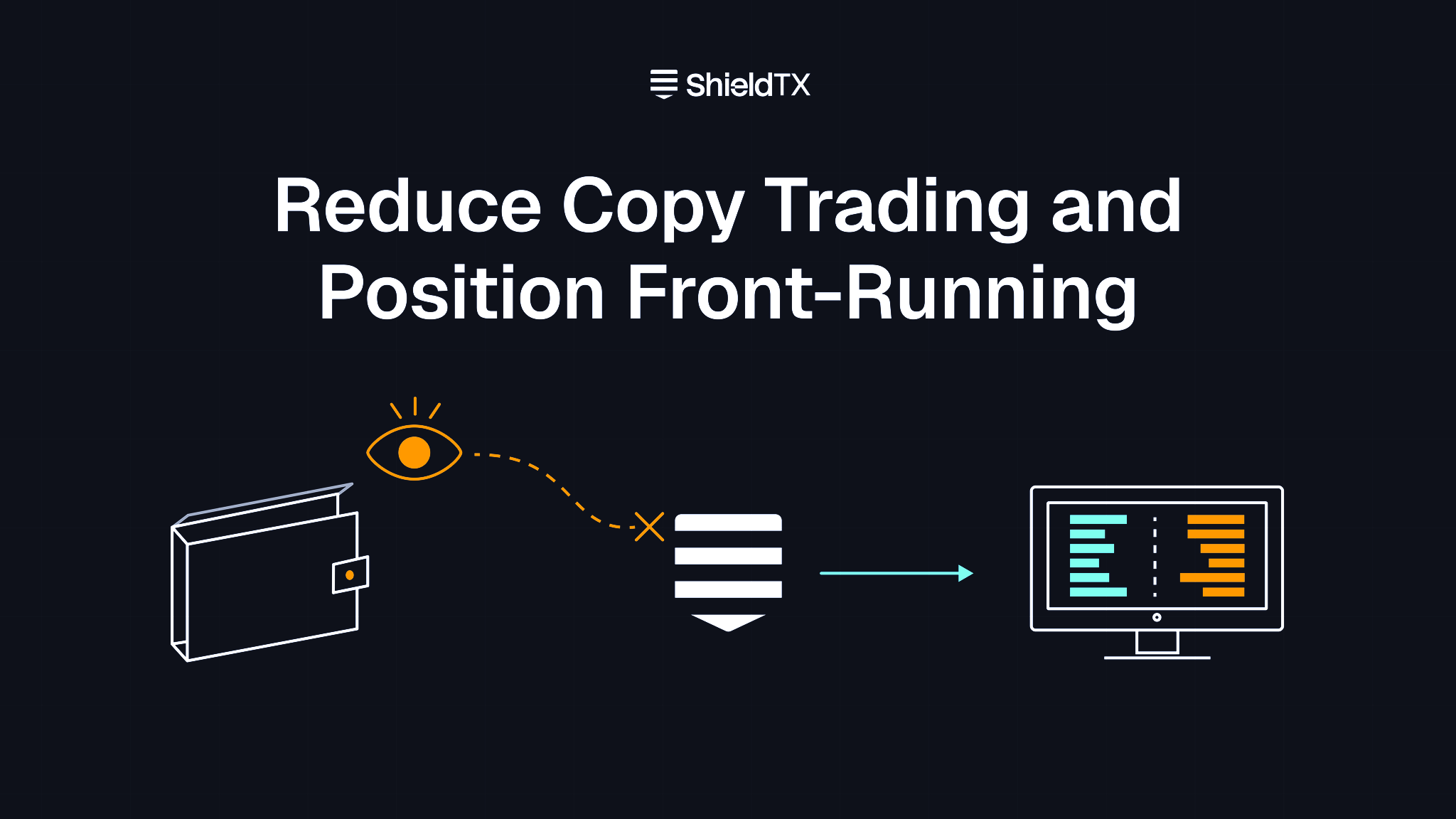
On Hyperliquid, a profitable trading wallet can become a public signal. Once observers identify the address, they can monitor new positions, compare them with earlier trades and act on the information. Some may mirror the trade. Others may use the position, size and timing to anticipate what the trader is likely to do next.
Why copy trading and position front-running matter for high-volume traders
Every open position on Hyperliquid can be read in real time: the market, the direction, the size, the leverage and the liquidation level are all public. For a retail trader that transparency is useful. For a fund, market maker or whale, the same transparency turns a trading strategy into a live signal anyone can watch.
Two forms of behaviour exploit that signal. Copy trading mirrors the trade once it becomes visible, riding the same market and direction. Position front-running goes further: it uses the visible position, its size and the wallet's history to predict the trader's next move and trade ahead of that expectation. Both depend on the same thing, attribution, the ability to connect a position to a specific wallet and its past behaviour.
Shielding does not remove the trade from Hyperliquid or hide the position. It removes the link between the position and a recognisable wallet. Without that link, a position carries much less information: it has no history, no pattern and no identity for an observer to act on.
How public attribution can erode a trading edge
Followers can add pressure after an entry
If an address is actively monitored, follower wallets can enter the same market and direction shortly after it. In a liquid market, the effect may be small. In a thinner market or around a larger order, follow-on activity may contribute to short-term price movement and make later fills or position additions less favourable.
Position size can become a conviction signal
Observers can compare a new position with the wallet's historical size. A trade that is unusually large may be interpreted as higher conviction. Copy traders may respond more aggressively to the positions that matter most to the original trader.
Adjustments can reveal the execution plan
Repeated additions, partial closes and collateral changes can show how the trader manages a position. Over time, observers may learn whether the wallet scales in gradually, cuts risk at a particular drawdown or tends to take profit after a familiar move.
Visible risk levels can attract attention
Liquidation information can show where a position may become vulnerable if the market moves against it. A visible level does not prove that another participant can force a liquidation. It does, however, provide information about where forced action may occur and how the position could react under stress.
What a public Hyperliquid wallet can reveal
Every Hyperliquid account is public. Anyone can look up a wallet address and inspect its positions and risk in real time. That transparency supports verifiability, but it also leaves a persistent public record of how a trader operates.
A single trade may reveal little. A long-running wallet can reveal much more. Repeated activity can show preferred markets, typical sizing, entry timing, risk tolerance, collateral management and the conditions under which a trader tends to reduce or close a position.
Copy trading and position front-running are different
Copy trading follows an observed position
A copy trader monitors another wallet and opens a similar position after the original trade becomes visible. The follower may copy the market, direction and approximate size manually or through an automated system, and dedicated copy-trading tools make that easy to do at scale. To see how much follower behaviour your own wallet attracts, the ShieldTX wallet scanner shows how many wallets enter the same market and direction after your trades.
The copied order does not need to arrive before the original trader's order. It only needs to arrive quickly enough for the follower to benefit from the original trader's signal. If many wallets react to the same address, their combined activity may add follow-on pressure after the first entry.
Position front-running anticipates the trader's next action
In this article, position front-running refers to using a visible position and its history to trade in anticipation of the trader's likely next action. It may include entering before an expected add, positioning around a likely exit or using a visible risk boundary to prepare for forced selling or buying.
This is not necessarily the same as mempool front-running or transaction reordering. Hyperliquid positions generally become useful to copy traders after they are reflected in the venue's public state. The risk discussed here is informational: public account data can help another participant form and act on a prediction about the trader.
Why common workarounds are incomplete
Manual wallet rotation
A trader may create a new wallet so that the next position does not appear under the recognised address. This can reduce immediate recognition, but the funding path, timing, trade size and repeated behaviour may reconnect the new wallet to the original trader. Each additional wallet also adds balances, keys, permissions and reporting work.
Changing size or timing
Randomising order size, delaying entries or changing normal execution patterns can make behaviour harder to classify. It can also make the trader execute a strategy less efficiently. Protection that depends on deliberately trading worse introduces its own performance cost.
Splitting a position
Breaking one position into smaller orders may reduce the signal created by any single fill. The completed position can still become visible, and repeated order patterns may reveal that the trades belong to one execution plan.
Trading through a centralised exchange
A centralised venue can hide the account state from public onchain observers, but it also moves execution away from Hyperliquid and introduces a different custody, counterparty and operational model.
What reducing copy trading realistically means
There are two different objectives:
- Preventing anyone from seeing that a position exists
- Reducing the public connection between the position and a trader with a recognisable history
The first objective is not how trading on Hyperliquid works. The execution wallet and its position remain part of Hyperliquid's public account state.
The more realistic objective is attribution separation. If a new position cannot be easily connected to the main wallet and its earlier trades, an observer has less context for deciding whether the position is worth copying or what it may reveal about the trader's broader strategy.
The position remains visible. The persistent identity and accumulated strategy profile are better separated.
How shielded execution changes attribution
A shielded execution layer separates the wallet supplying funds from the wallet that executes and holds the position. With ShieldTX, the general workflow is:
- The trader deposits USDC into a ShieldTX balance.
- The trader submits a Hyperliquid perpetual order through ShieldTX.
- A fresh trading wallet is funded for the position.
- The order is routed to Hyperliquid's native order book.
- The resulting position is held by the fresh trading wallet.
- When the position is closed through ShieldTX, the proceeds return to the shielded balance.
The trade and position remain visible on Hyperliquid. What changes is the relationship between that execution wallet and the trader's recognised funding wallet. A fresh wallet without an established public history provides less information to a system deciding which trader is worth following.
Using separate execution wallets can also limit how much strategy history accumulates under one address. Observers may still analyse an individual position, but they have less persistent wallet history through which to interpret it.
Direct trading vs manual workarounds vs shielded execution
| Area | Direct trading | Manual workarounds | Shielded execution |
|---|---|---|---|
| Position visibility | Visible on the recognised wallet | Visible on rotated or split wallets | Visible on the execution wallet |
| Link to trading history | Direct | May be reconstructed | Designed to reduce the direct public link |
| Copy-trader signal | Recognised wallet provides context | Reduced only if wallets remain unlinked | Fresh wallet has limited public history |
| Behavioural analysis | Accumulates under one address | Can continue across clustered wallets | Separated across execution wallets |
| Hyperliquid execution | Native | Native when wallets trade directly | Native order book |
| Operational overhead | Lower | Increases with wallets and transfers | Managed within the ShieldTX workflow |
| Market impact | Unchanged | Unchanged | Unchanged |
| Trading risk | Remains | Remains | Remains |
What remains publicly visible with ShieldTX
ShieldTX should not be interpreted as making Hyperliquid trading invisible. The execution wallet, its market, direction, size, entry, mark price, PnL, leverage, margin mode, liquidation price, orders and its eventual close or liquidation all remain public, as do deposits into and withdrawals from the ShieldTX system and solver and settlement activity. Shielding separates the position from your main wallet; it does not hide the position itself.
Large trades may still affect the market. A distinctive strategy may still create behavioural clues. ShieldTX is designed to reduce the direct public relationship between the execution activity and the trader's main wallet, not to remove every possible signal.
Practical steps to reduce copy-trader exposure
Measure the current exposure
Start with the recognised wallet. Review which positions, PnL information, liquidation levels and historical patterns are publicly available. The ShieldTX wallet scanner automates the first pass: it checks your wallet's trading activity and shows how many wallets enter the same market and direction after your trades.
Separate custody and execution deliberately
Do not assume that creating another address creates a separate identity. Review the funding path, timing, withdrawal flow and behavioural signals that may reconnect it to the primary wallet.
Avoid publishing unnecessary wallet associations
Public profiles, dashboards, screenshots and transaction links can connect an otherwise pseudonymous address to a trader or institution. Review which addresses are disclosed through operational and communications workflows.
Control information outside the chain
Wallet separation cannot protect information leaked through API credentials, shared dashboards, alerting systems or internal access. Professional teams should apply appropriate permissions, monitoring and incident-response controls around their trading infrastructure.
Evaluate protection alongside execution quality
Review where orders execute, which order types are supported, what fees apply and whether privacy routing introduces latency. ShieldTX routes orders to Hyperliquid's native order book, but shielded routing introduces a delay of a few seconds.
How to access ShieldTX
ShieldTX is a non-custodial execution privacy layer for Hyperliquid perpetuals.
It is currently onboarding professional traders, funds and systematic desks through a private beta. Teams can request access and discuss API integration for their existing workflows.
Frequently asked questions
Can copy trading be completely prevented on Hyperliquid?
No system can prevent another trader from independently placing a similar order. ShieldTX is designed to reduce the direct public attribution that makes a recognised wallet easy to monitor and copy.
Does ShieldTX hide the position from Hyperliquid?
No. The position remains visible at the execution wallet and trades through Hyperliquid's native order book. The privacy benefit comes from separating that wallet from the trader's recognised funding wallet and broader history.
Is position front-running the same as MEV front-running?
Not necessarily. In this article, position front-running means using visible account information to anticipate a trader's likely next action. It does not imply that a transaction was reordered or inserted ahead of another transaction.
Will a fresh wallet stop every form of analysis?
No. Observers may still analyse market impact, timing, order behaviour and the individual position. A fresh wallet reduces persistent attribution; it does not remove all market signals.
Does ShieldTX change Hyperliquid fills or liquidity?
Orders are routed to Hyperliquid's native order book. Shielding does not create a separate liquidity venue, although the routing process introduces a delay of a few seconds and ShieldTX fees are shown separately.
Does shielded execution remove liquidation risk?
No. Positions remain subject to Hyperliquid's normal margin, funding and liquidation mechanics. Privacy separation complements risk management; it does not replace it.
Can systematic trading teams use ShieldTX?
API access is available upon request for selected teams. A systematic desk should review authentication, supported order types, latency, failure handling, reconciliation and operational controls before integration.