
How to Keep PnL and Liquidation Levels Private on Hyperliquid
Hyperliquid positions are public, and that public surface goes deeper than most traders expect. The market, the size, the entry, the leverage, the unrealised PnL and the liquidation price are all queryable from a wallet address, and every position adds another data point to a wallet's permanent trading history. The question is what to do about it. This article looks at what Hyperliquid reveals about a position, why wallet rotation is rarely enough, and what shielded execution can and cannot change.
What Hyperliquid makes public
Onchain perpetual trading makes every position easy to inspect. A public wallet on Hyperliquid exposes a continuous record of the markets it trades, the size and direction of each position, its entry, its leverage, its unrealised PnL and the liquidation price the exchange will trigger. Open orders, position adjustments and historical trading behaviour are all part of public state.
A single position may not reveal an entire strategy. Repeated observation, however, can show how a trader enters markets, manages risk, adds collateral and responds to changing prices.
That information can be useful to competitors, counterparties, copy traders and anyone attempting to anticipate the trader's next action.
What Hyperliquid reveals about a position
Hyperliquid account information can be queried using a public wallet address. The result may include open positions, margin information, unrealised PnL and the liquidation price associated with a position.
This visibility can reveal more than whether a trader is profitable.
Unrealised PnL can reveal pressure
A large negative PnL may suggest that a trader is under pressure to reduce the position, add collateral or accept a loss.
A large positive PnL may indicate where the trader entered and how much profit remains exposed if the market reverses.
Neither signal proves what the trader will do next. However, it gives observers additional information that would not normally be available from an account on a centralised venue.
Liquidation levels can reveal forced exit risk
A visible liquidation price shows where a position may become vulnerable if the market continues moving against it.
This is particularly relevant for:
- Large positions
- Thin or volatile markets
- Highly leveraged trades
- Wallets associated with recognised traders
- Strategies that repeatedly trade similar markets
The liquidation price may change as funding accrues, collateral changes or other cross-margin positions move in value. Even so, the displayed level provides observers with a useful estimate of the account's risk boundary.
Trading history can reveal future behaviour
Observers can also compare current positions with earlier trades from the same wallet.
Over time, they may identify patterns in:
- Preferred markets
- Typical position sizes
- Entry timing
- Leverage
- Stop-loss behaviour
- Profit-taking
- Collateral management
- Re-entry after closing a trade
A single PnL figure is one data point. A wallet that has traded the same markets, at the same size, with the same leverage, for months is a strategy feed. Once an observer can read that feed, they can anticipate entries, copy trades within seconds, or push a price toward a known liquidation level. The problem is therefore not limited to one public PnL figure. It is the persistent history created when every position is tied to the same recognised wallet.
Curious whether this is already happening to your wallet? The ShieldTX wallet scanner checks the last 30 days of your trading activity and shows how many wallets entered the same market and direction shortly after you. Scan your public Hyperliquid wallet exposure.
Why wallet rotation doesn't fix the problem
A common response is to open the next position from a new wallet.
This may reduce immediate recognition, but a new address does not automatically create a private trading identity. Several signals can reconnect it to the original trader.
The funding path may be visible
If the new wallet receives funds directly from a known wallet, an observer can follow that transfer and inspect the new address. Moving funds through the same sequence of addresses can create a repeatable pattern rather than meaningful separation.
Timing can create a relationship
A wallet that is funded shortly before opening a familiar position may be connected through timing, particularly when the trade follows activity associated with the original wallet.
Trade size and behaviour can be recognisable
A trader may rotate wallets while continuing to use similar markets, position sizes, leverage and execution patterns. The address changes, but the behaviour behind it does not.
More wallets create more operational work
Every additional wallet introduces another balance, key, permission set and transaction history to manage. For professional trading teams, manual rotation can increase the work required for funding, reconciliation, reporting, monitoring and incident response.
Wallet rotation can support account organisation. It should not be treated as proof that PnL and liquidation exposure can no longer be attributed to the same trader.
What keeping PnL private realistically means
There are two different privacy objectives:
- Making the position itself invisible
- Reducing the public connection between the position and the trader
The first is not how trading on Hyperliquid works. The execution wallet, position and associated market information remain visible.
The more realistic objective is attribution privacy.
An observer may still see that a wallet holds a long or short position, along with its PnL and liquidation level. The privacy benefit comes from making it more difficult to connect that execution wallet to the trader's recognised funding wallet and wider trading history.
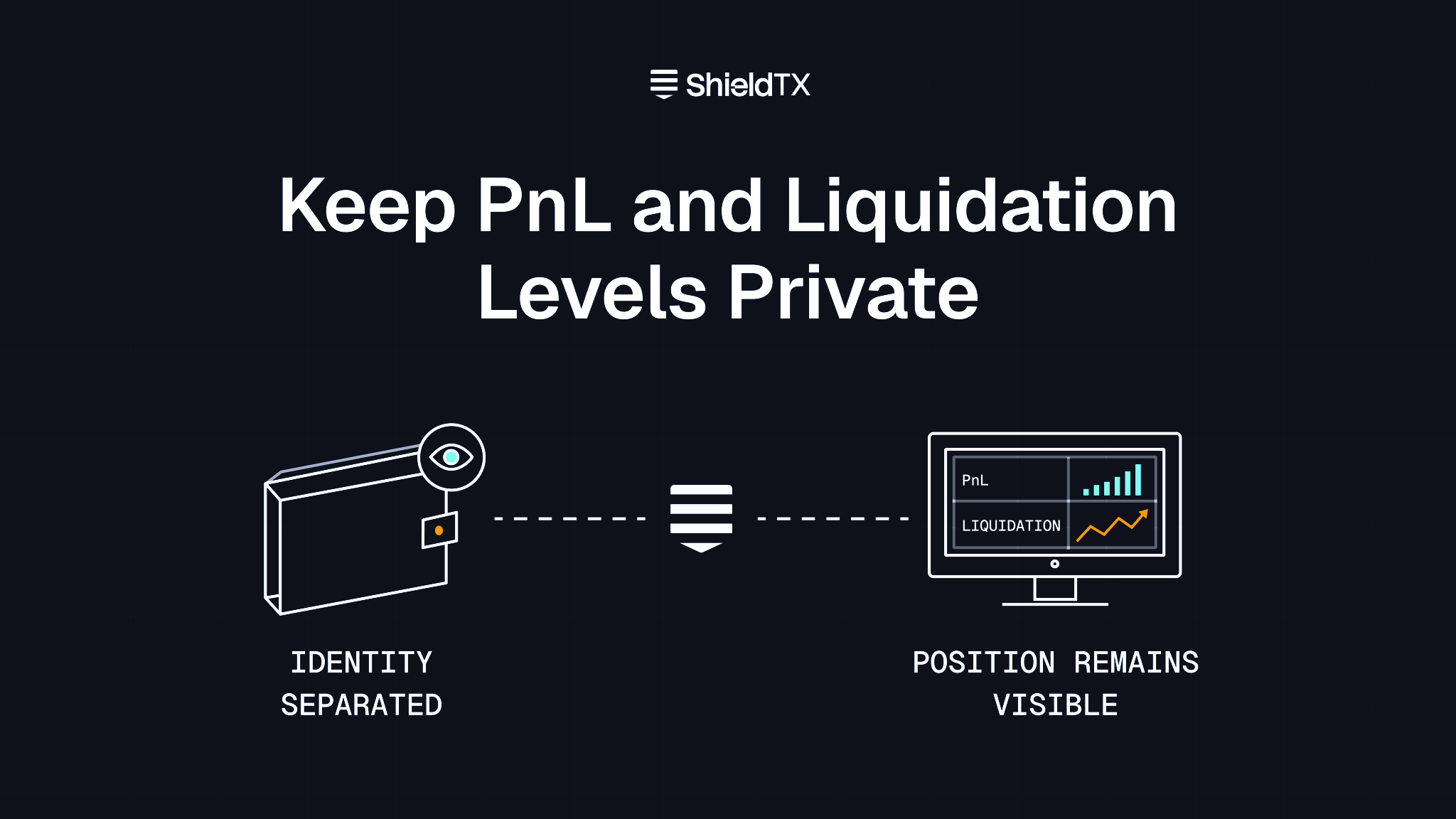
The position remains public. The identity behind the position is better separated.
This is the boundary that traders should evaluate when comparing wallet rotation with a shielded execution system.
How shielded execution changes the relationship
A shielded execution layer separates the wallet that supplies the funds from the wallet that executes and holds the position. With ShieldTX, the general workflow is:
- The trader deposits USDC into a ShieldTX balance.
- The trader submits a Hyperliquid perpetual order through ShieldTX.
- A fresh trading wallet is funded for execution.
- The order is routed to Hyperliquid's native order book.
- The resulting position is held by the fresh trading wallet.
- When the position is closed through ShieldTX, the proceeds return to the shielded balance.
The position, PnL and liquidation level remain visible at the execution wallet.
What changes is the public relationship. The position is not held directly by the trader's recognised funding wallet, and the fresh trading wallet is managed as part of the ShieldTX execution flow rather than manually created and funded by the trader.
Direct trading vs wallet rotation vs shielded execution
| Area | Single Wallet | Manual wallet rotation | ShieldTX |
|---|---|---|---|
| Position visibility | Visible on the trader's wallet | Visible on the rotated wallet | Visible on the execution wallet |
| Unrealised PnL | Publicly observable | Publicly observable | Publicly observable |
| Liquidation level | Publicly observable | Publicly observable | Publicly observable |
| Link to recognised wallet | Direct | May be reconstructed from funding and behaviour | Breaks the public link |
| Wallet management | One primary wallet | Multiple wallets managed manually | Multiple wallets, one account. |
| Trading history | Accumulates on the recognised wallet | Fragmented across rotated wallets | Separated across execution wallets |
| Hyperliquid execution | Native | Native | Native |
| Liquidation risk | Unchanged | Unchanged | Unchanged |
| Operational burden | Low | Increases with every wallet | Low |
The main difference is not whether market information exists. It is where that information appears and how easily the execution wallet can be connected to the trader.
What remains publicly visible with ShieldTX
ShieldTX should not be interpreted as making Hyperliquid positions invisible. Observers may still see:
- The execution wallet
- The market being traded
- Position direction and size
- Entry and mark-price information
- Unrealised PnL
- Leverage and margin mode
- Liquidation price
- Order and position changes
- The eventual close or liquidation of the position
Onchain deposits into and withdrawals from the ShieldTX system may also remain visible.
ShieldTX is designed to reduce the direct relationship between those public execution details and the trader's funding wallet. It does not remove every possible signal or make trading activity disappear.
Privacy does not change liquidation risk
Separating a position from a recognised wallet does not make that position safer.
Hyperliquid liquidations depend on factors including:
- Account equity
- Maintenance margin
- Position size
- Mark price
- Margin mode
- Collateral
- Funding payments
- Other positions sharing cross margin
A position routed through ShieldTX remains subject to Hyperliquid's normal margin and liquidation mechanics.
ShieldTX does not remove:
- Market risk
- Leverage risk
- Funding costs
- Slippage
- Liquidation risk
- Smart-contract risk
- Venue risk
- Operational risk
Traders remain responsible for monitoring their positions, collateral and liquidation boundaries. Privacy separation should complement risk management, not replace it.
Practical considerations for professional traders
Privacy scope
Identify exactly which relationship is being reduced. The position remains public, so the relevant question is whether it can be connected to the desk's recognised wallet.
Execution quality
Review where the order executes, which order types are supported and whether routing introduces additional latency or costs. ShieldTX routes orders to Hyperliquid's native order book, but shielded routing introduces a delay of a few seconds.
Control and permissions
Understand who controls the funding wallet, execution wallet, contracts, withdrawals and emergency actions.
Risk monitoring
Ensure that the team can continue monitoring open positions, margin, PnL and liquidation levels even when those positions are not held by the primary wallet.
Reconciliation
Confirm how positions, realised PnL, fees and withdrawals will be recorded within the desk's reporting and accounting systems.
Integration
Systematic teams should review API support, authentication, rate limits, failure handling and how shielded execution fits within their existing order-management workflow.
How to access ShieldTX
ShieldTX is a non-custodial execution privacy layer for Hyperliquid perpetuals.
It is currently onboarding professional traders, funds and systematic desks through a private beta. Teams can request early access and discuss API integration for their existing workflows.
Frequently asked questions
Can PnL be completely hidden on Hyperliquid?
ShieldTX is designed to reduce the direct connection between positions and the trader's known wallet.
Are liquidation levels hidden when using ShieldTX?
No. The liquidation level associated with the position remains visible on the execution wallet. The privacy benefit is that the position is not held directly by the trader's primary wallet.
Does ShieldTX prevent other traders from seeing the position?
No. The position remains part of Hyperliquid's public account state. ShieldTX reduces attribution rather than making the market activity invisible.
Is wallet rotation enough to keep a position private?
Not necessarily. Funding transfers, timing, trade size and repeated trading behaviour may reconnect a fresh wallet to a recognised address.
Can a trader still monitor PnL through ShieldTX?
Yes. Traders still need visibility into their execution wallets and open positions to manage risk. Privacy from public attribution does not mean hiding the position from the trader operating it.
Does ShieldTX execute trades away from Hyperliquid?
No. ShieldTX routes perpetual orders to Hyperliquid's native order book.
Is ShieldTX custodial?
No. ShieldTX is non-custodial. Funds are locked in a user-controlled smart contract on Arbitrum and core operations are permissionless. See the ShieldTX trust model for the full custody model.