
How Institutions Can Trade Hyperliquid Perps Privately
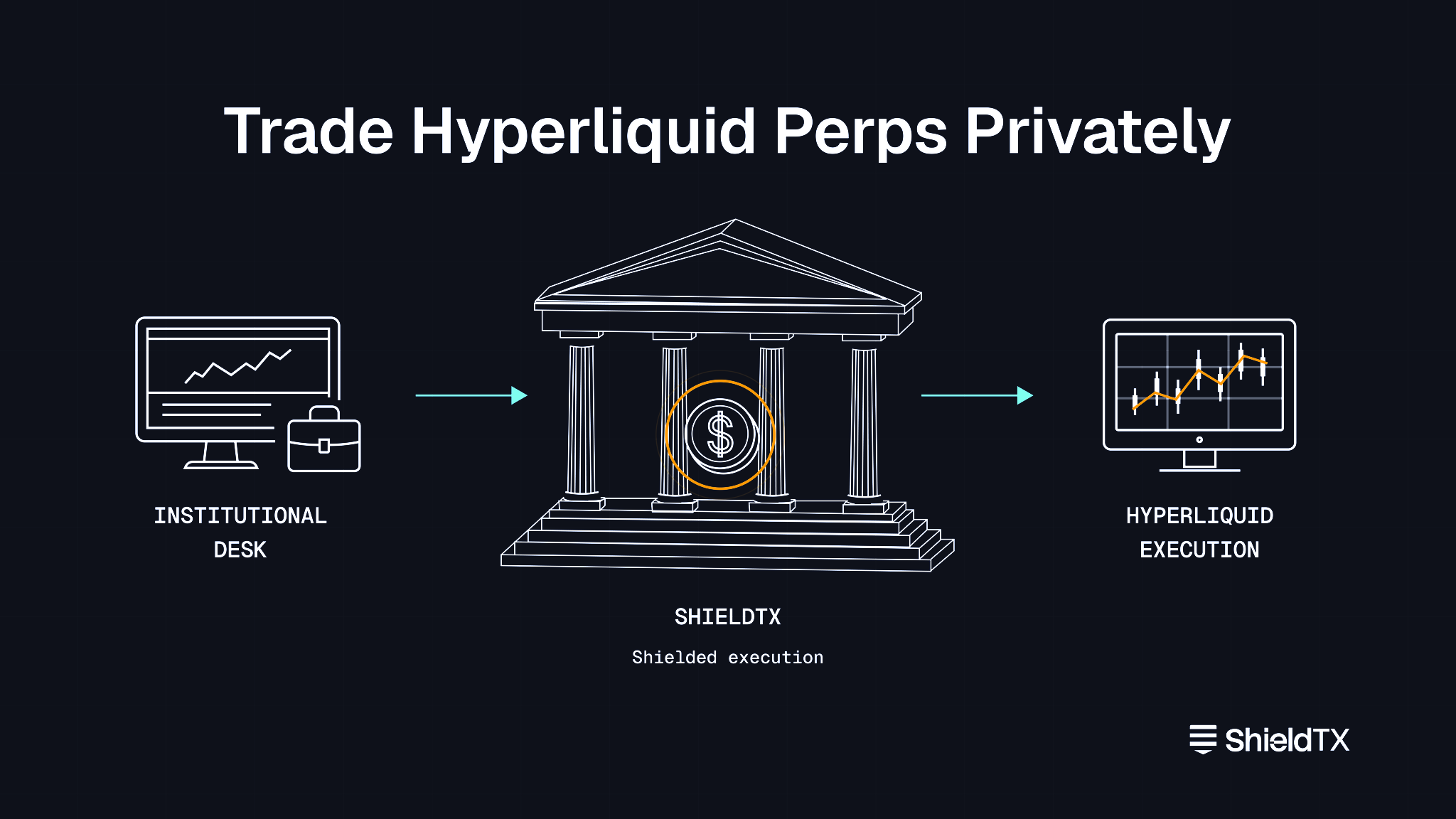
Reduce the direct public link between an institution's funding wallet and its Hyperliquid positions.
Institutional Hyperliquid trading creates a public strategy trail
Hyperliquid gives professional traders access to an onchain order book, deep activity across perpetual markets and an API suited to automated execution. The same public infrastructure also makes account activity observable. When an institution trades from a known wallet, the market can monitor its positions, direction, approximate entry, leverage, unrealised PnL, liquidation levels and trading history.
For an individual trader, that visibility can attract copy traders. For a fund, market maker or trading desk, it can expose research, inventory, hedging behaviour, risk limits and execution patterns. A wallet can become a live strategy feed long before the institution intends to communicate a view to the market.
The institutional objective is not to make market activity disappear. It is to reduce the direct public link between the institution's recognised funding wallet and each position it opens on Hyperliquid.
What public attribution can reveal
| Public signal | What observers may infer |
|---|---|
| Direction and size | Conviction, portfolio bias or a developing thesis |
| Entry and adjustments | Execution style, accumulation pattern and risk tolerance |
| Leverage and margin | Capital efficiency targets and proximity to forced liquidation |
| Open interest over time | Whether the desk is building, hedging or unwinding exposure |
| PnL and liquidation levels | Performance, stress and possible pressure points |
| Repeated wallet behaviour | Links between strategies, mandates, operators or counterparties |
None of these observations proves the institution's intent. But together they can create a useful signal for copy traders, competitors and counterparties.
Why operational separation is not the same as privacy
Subaccounts organise activity
Hyperliquid subaccounts can separate balances, strategies and permissions for operational purposes. That is useful for desk organisation and risk management. It does not automatically make the underlying account activity private. Public addresses and their positions can still be queried and monitored.
API wallets delegate signing
Hyperliquid API wallets, also called agent wallets, can sign on behalf of a master account or subaccount. They support programmatic trading, but account data is still queried using the relevant master or subaccount address. Delegated signing should therefore not be treated as an execution-privacy feature.
Manual wallet rotation adds overhead
Institutions can spread activity across wallets, but repeated funding paths, timing, trade sizes and behavioural patterns still create links. More wallets also increase key management, gas, reconciliation, reporting and operational risk.
Centralised exchange routing changes the venue
A centralised venue can remove the public exposure, but it also changes the liquidity, custody, counterparty and execution model. That does not solve the problem for a desk that specifically wants Hyperliquid's order book.
What private institutional execution should preserve
- Hyperliquid execution. Orders should continue to access Hyperliquid's native order book, markets, liquidity and fills.
- A clear privacy boundary. The product should state what is separated from the institution's public identity and what remains observable.
- Institutional control. Teams should understand custody, smart-contract control, permissions, withdrawal paths and emergency procedures.
- Operational fit. Systematic traders need APIs, reliable order handling and workflows that can fit existing trading infrastructure.
- Transparent cost and latency. Fees, routing delay and execution constraints should be visible before a desk deploys capital.
- Regulatory fit. The solution should preserve the institution's regulatory compliance and fit its legal, security and risk requirements.
How ShieldTX fits
ShieldTX is a non-custodial execution privacy layer for Hyperliquid perpetuals. A trader funds a ShieldTX balance, places a perp order through ShieldTX, and a fresh wallet is funded to route that order to Hyperliquid's native order book. When the position is closed through ShieldTX, the proceeds return to the shielded balance.
The position and market activity remain visible on Hyperliquid. What ShieldTX is designed to reduce is the direct public link between the institution's funding wallet and the fresh wallet holding the position. Positions, PnL, liquidation levels, order history and position wallets are therefore not publicly tied to the main wallet in the same way.
ShieldTX does not remove price movement, funding, leverage, liquidation, smart-contract, venue or operational risk. It also introduces a routing delay of a few seconds, and ShieldTX fees are shown separately.
If you're already trading perps on Hyperliquid you can test your exposure. Our wallet scanner checks your wallet's trading activity and identifies how many wallets are trading in the same market and direction straight after you place your trades. Data is valid for the last 30 days only. Scan your public Hyperliquid wallet exposure.
A four stage institutional workflow
- Fund the ShieldTX balance. Deposit USDC into ShieldTX. The deposit remains visible onchain, while the funds sit in ShieldTX's on-chain vault on Arbitrum and move only when you sign for them.
- Submit the order. Place the Hyperliquid perp trade through the ShieldTX application or an approved API workflow.
- Execute through a fresh wallet. ShieldTX creates a fresh Hyperliquid wallet, unlinked to the funding wallet, and routes the order to Hyperliquid's order book. The position is visible, but it is not directly attributed to the institution's funding wallet.
- Close and settle. Close through ShieldTX and return the proceeds to the shielded balance, separate from the wallet that held the position.
ShieldTX is non-custodial. Funds are locked in an on-chain vault on Arbitrum, core operations are permissionless and verified by zero-knowledge proofs. Only you can claim your funds, with a signed transaction. Review the trust model for details.
Where the model can help institutional teams
| Team | Potential use |
|---|---|
| Fund manager | Test or build a position without turning a known treasury wallet into a public conviction signal |
| Market maker | Reduce the trading intelligence competitors can derive from visible inventory, position history and wallet linking |
| Systematic desk | Execute selected strategies while separating positions from the main funding wallet |
| Institutional hedger | Limit public attribution around a hedge that could reveal exposure elsewhere in the portfolio |
| Proprietary trader | Protect research and execution patterns from becoming a persistent public feed |
How ShieldTX supports institutional requirements
- Privacy scope. A clear boundary: the link between your funding wallet and your positions is reduced, and what remains public is easy to assess.
- Control model. Non-custodial by design: funds sit in an on-chain vault on Arbitrum and move only on your signed transaction.
- Execution. Hyperliquid's native order book with a defined routing delay and clear handling of fills, cancellations and failed transactions.
- Risk. The same leverage, margin, funding and liquidation mechanics as trading on Hyperliquid directly, documented alongside smart-contract and operational risk.
- Economics. Transparent ShieldTX fees, Hyperliquid fees and gas for the routing step, visible before you deploy capital.
- Operations. API access, key management, rate limits, reconciliation, monitoring and incident response for live desks.
- Regulatory fit. Designed so legal, compliance, accounting and reporting requirements can be reviewed against the institution's own obligations.
How to access ShieldTX
ShieldTX is onboarding professional traders through a private beta. Selected trading desks and institutions can request early API access to fit existing workflows.
Frequently asked questions
Does ShieldTX make institutional trades invisible?
No. The institution's exposure remains visible on Hyperliquid. ShieldTX is designed to reduce the direct public link between the institution's funding wallet and the wallet holding the position.
Do orders still execute on Hyperliquid?
Yes. ShieldTX routes orders to Hyperliquid's native order book, where they access Hyperliquid liquidity and fills.
Can an institution use an API?
Early API access is available on request for selected teams and institutions.
Are Hyperliquid API wallets private?
No. API wallets delegate signing authority. Hyperliquid documentation states that account data is queried using the actual master or subaccount address.
Does ShieldTX add latency?
Yes. Shielded routing adds a delay of a few seconds before an order reaches Hyperliquid.
Is ShieldTX custodial?
ShieldTX is non-custodial. Funds are locked in an on-chain vault on Arbitrum and move only when you sign for them. See the ShieldTX trust model for details.